How to Teach Rational and Irrational Numbers in 8th Grade: Free Notes
Want the free Rational and Irrational Numbers notes? Click here
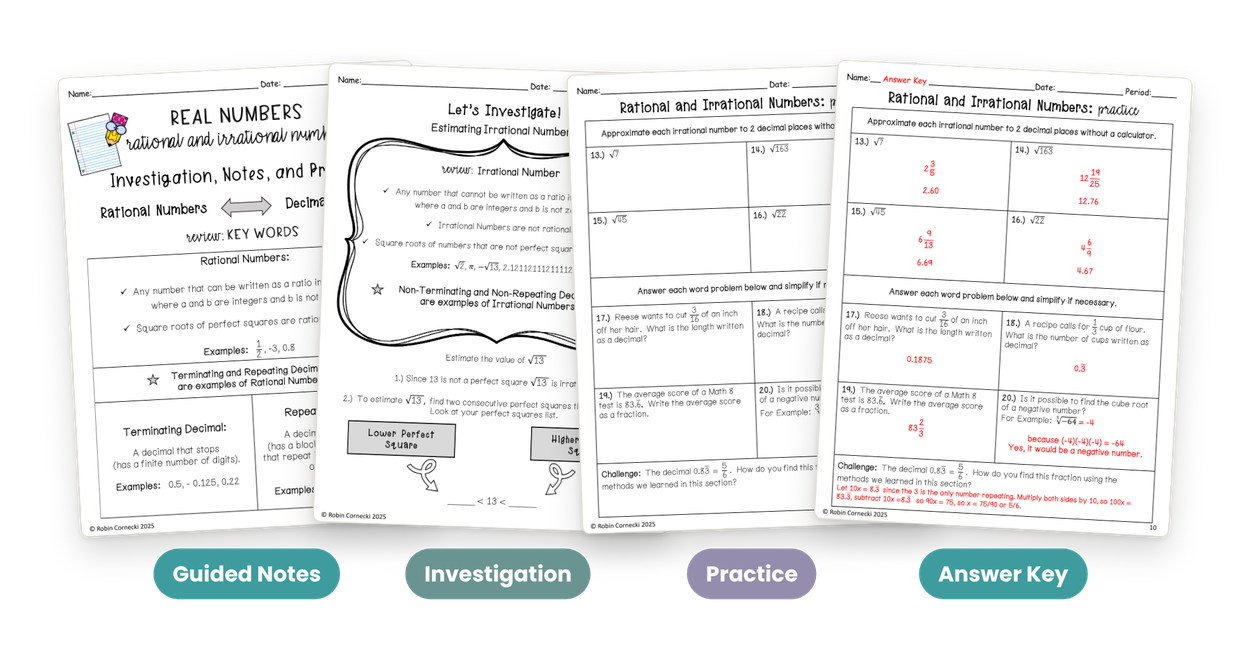
If you are planning how to teach rational and irrational numbers in 8th grade, here are the notes I use with my own students, and they are free: guided notes, an investigation on estimating irrational numbers, two practice pages and a full answer key.
Below is how the notes run, part by part. Type your email on the sign-up page and the PDF is yours right away.
How to teach rational and irrational numbers: start with the decimals
A rational number can be written as a fraction a/b of two integers, with b not zero. Its decimal either stops (0.5) or repeats (0.333...). An irrational number cannot be written as a fraction: its decimal goes on forever without repeating, like pi or the square root of 2.
So the decimal is the test, and that is where the notes start. Students turn fractions into decimals, then repeating decimals back into fractions, then meet square roots and cube roots. Once they see that the square root of a perfect square is a whole number and the square root of any other whole number is irrational, they estimate those irrational square roots without a calculator.
The lesson at a glance
- Grade: 8th grade
- Standard: Common Core 8.NS.A.1: know that numbers that are not rational are called irrational. Understand informally that every number has a decimal expansion; for rational numbers show that the decimal expansion repeats eventually, and convert a decimal expansion which repeats eventually into a rational number
- Standard: Common Core 8.NS.A.2: use rational approximations of irrational numbers to compare the size of irrational numbers, locate them approximately on a number line diagram, and estimate the value of expressions
- Standard: Common Core 8.EE.A.2: use square root and cube root symbols to represent solutions to equations of the form x2 = p and x3 = p, where p is a positive rational number. Evaluate square roots of small perfect squares and cube roots of small perfect cubes. Know that √2 is irrational
- You need: the notes, investigation and practice pages, one set per student, the answer key
- Students will be able to: tell rational from irrational numbers, change repeating decimals to fractions, solve x2 = p and x3 = p, and estimate irrational square roots
Get the free notes and answer key
Before you teach
Print the student pages for each student: six pages of notes, three pages of investigation and two practice pages. Keep the answer key for yourself. The notes have a table of perfect squares and perfect cubes that students use all the way through, so have them keep it handy.
Rational and irrational numbers guided notes: fractions and decimals
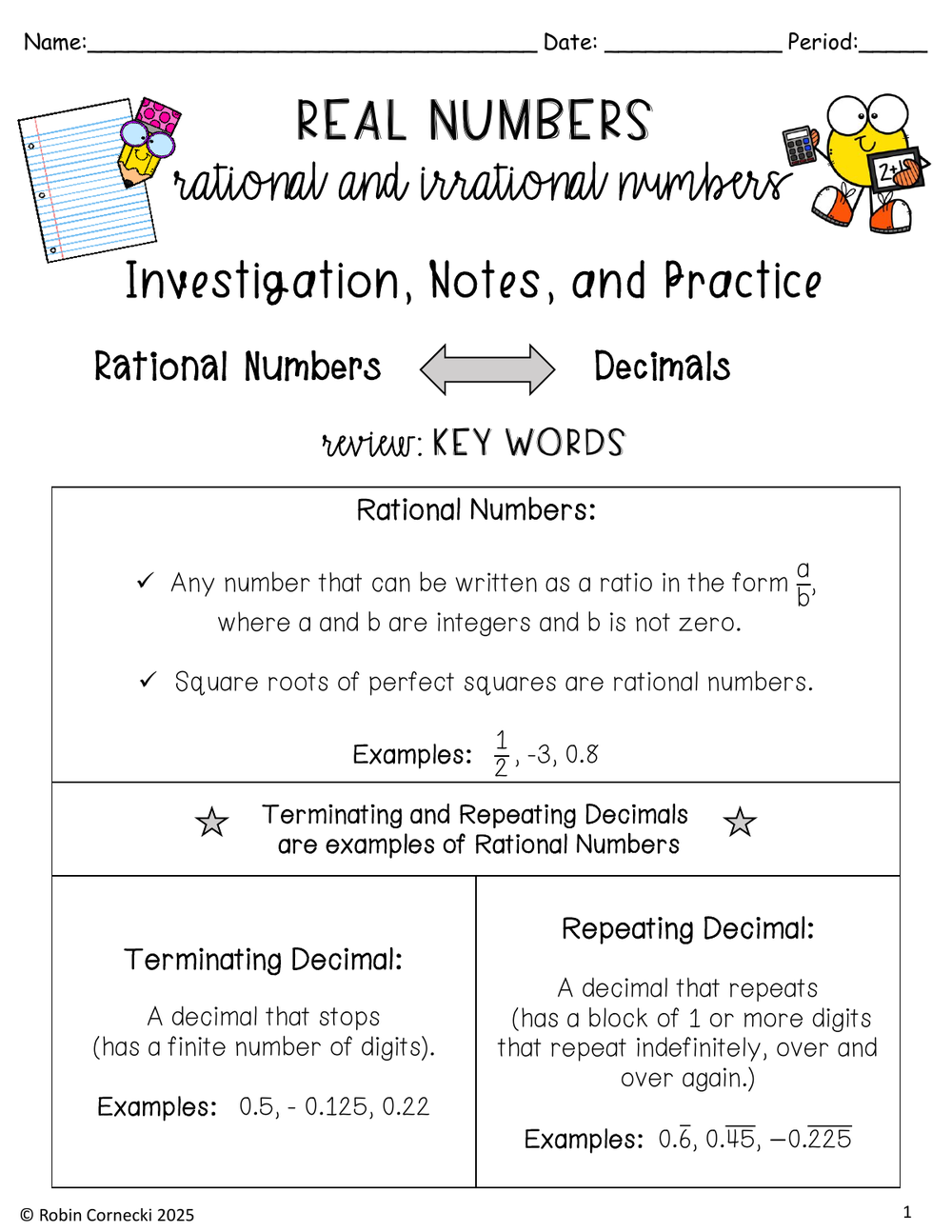
The notes open with the key words: rational numbers, terminating decimals and repeating decimals, with examples. Then students write fractions as decimals (the fraction bar means divided by) and decimals as fractions, with worked examples and a Your Turn after each.
The Think About It page shows how to turn a repeating decimal into a fraction with an equation. For 0.777..., let x = 0.777..., multiply both sides by 10 to get 10x = 7.777..., subtract x from both sides to get 9x = 7, so x = 7/9. One repeating digit means multiply by 10; two repeating digits means multiply by 100.
Guided notes: square roots and cube roots
Next come square root, principal square root, perfect square, cube root and perfect cube, with the table of perfect squares and cubes. Students solve equations like x2 = 36 (two answers, 6 and -6) and x3 = 125 (one answer, 5), including ones with fractions.
Let's investigate: estimating irrational numbers without a calculator
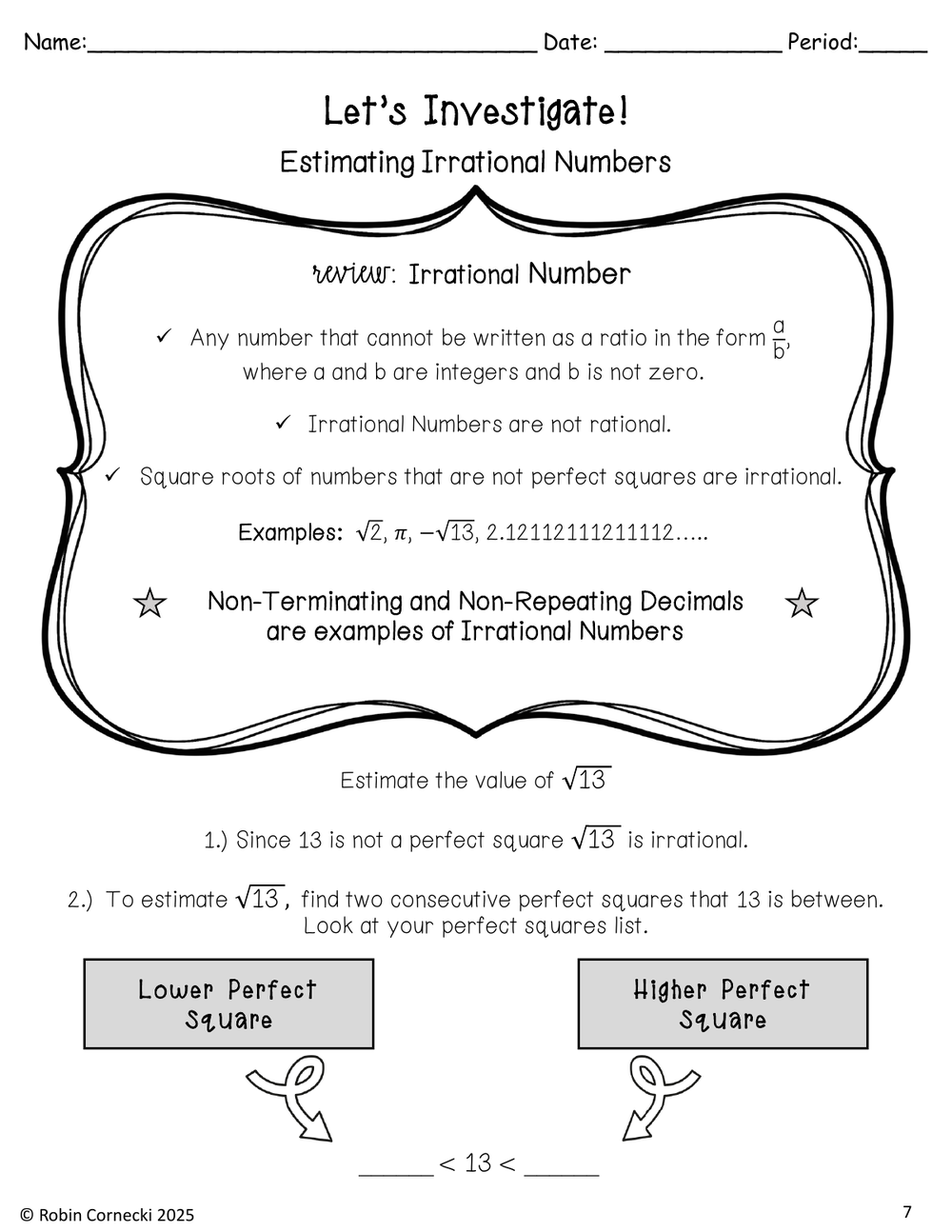
The three-page investigation walks students through a way to estimate a square root that is not a whole number. Here it is with the square root of 20:
- 20 is not a perfect square, so the square root of 20 is irrational.
- Find the two perfect squares it sits between: 16 < 20 < 25.
- Take their square roots: the square root of 20 is between 4 and 5.
- Find the fraction: (20 - 16) / (25 - 16) = 4/9.
- Put the whole number and the fraction together and change it to a decimal: 4 and 4/9 is about 4.44.
Practice: 20 problems and a challenge
Two practice pages pull it together: fractions to decimals, decimals to fractions, square root and cube root equations, estimating irrational numbers to two decimal places without a calculator, and word problems. The investigation ends with a reflection question (is there another way to estimate?), and the practice ends with a challenge problem.
The answer key
Every page has its own answer key page, the notes and the investigation included, so you can project it while you teach or use it to check the practice.
Here are the free Rational and Irrational Numbers notes
Type your name and email on the sign-up page. The PDF downloads on the next page, and a copy comes to your inbox.
- Six pages of guided notes
- A three-page investigation on estimating irrational numbers
- Two practice pages with 20 problems and a challenge
- The answer key for every page
These notes are from Unit 1, Real Numbers, of the 8th grade math in my membership
- Unit 1: Real Numbers
- Unit 2: Exponents and Scientific Notation
- Unit 3: Proportional Relationships
- Unit 4: Nonproportional Relationships
- Unit 5: Writing Linear Equations
- Unit 6: Functions
- Unit 7: Solving Linear Equations
- Unit 8: Solving Systems of Linear Equations
- Unit 9: Transformations and Congruence
- Unit 10: Transformations and Similarity
- Unit 11: Angle Relationships in Parallel Lines and Triangles
- Unit 12: The Pythagorean Theorem
- Unit 13: Volume
- Unit 14: Scatter Plots
- Unit 15: Two-Way Tables
See everything in the membership
Questions teachers ask about rational and irrational numbers
What is a rational and irrational number?
A rational number can be written as a fraction of two integers, like 3/4, -5 or 0.333... (which is 1/3). An irrational number cannot: its decimal never ends and never repeats, like pi or the square root of 2.
What is the difference between rational and irrational numbers?
Look at the decimal. If it stops or repeats, the number is rational. If it goes on forever with no repeating block, it is irrational. Square roots of perfect squares, like the square root of 49, are rational; square roots of other whole numbers are irrational.
Do the notes come with an answer key?
Yes. The answer key covers every page: the guided notes, the investigation and both practice pages.
Want every 8th grade math unit right now?
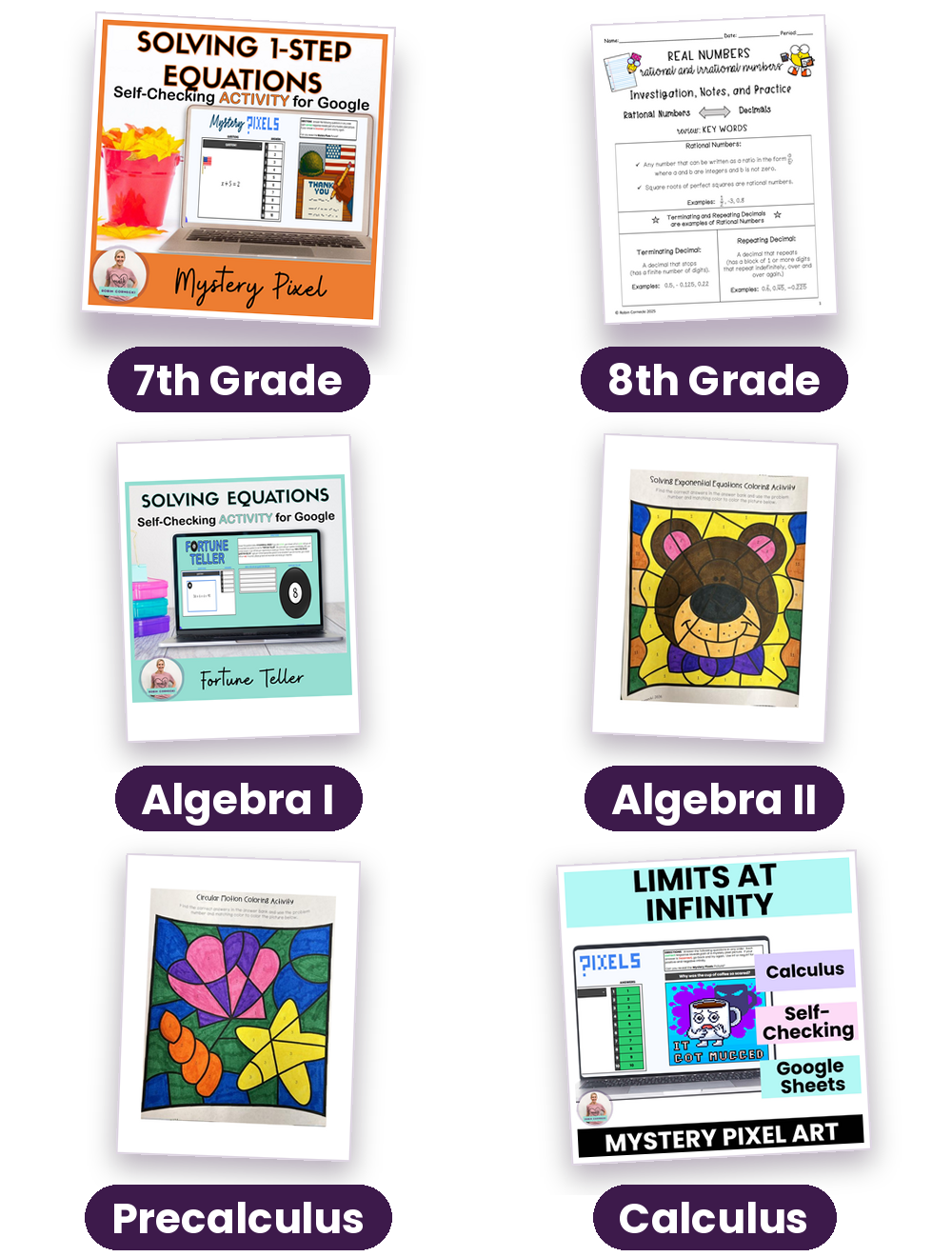
The membership has every course from 7th grade to Calculus: notes, activities, review games and tests, with answer keys. New lessons keep coming.

Get the free Rational and Irrational Numbers notes
Guided notes, the investigation, two practice pages and the answer key, in one PDF. Type your email and it is yours.
Pin this for later
Want more engaging resources like this one?
Notes, activities, review games and tests from 7th grade to Calculus, with answer keys. New lessons keep coming.